Understand ai voiceover copyright with a practical checklist for source rights, voice consent, disclosure, privacy and destination-platform rules. Treat “Copyright and AI Voiceovers” as an audio-production task rather than a one-click novelty. “Copyright and AI Voiceovers” is written for everyday users rather than developers, focusing on the script, voice, pronunciation, pacing, download quality, privacy and publishing choices that shape the final audio. To test the ideas in “Copyright and AI Voiceovers”, paste a short sample into TtsPlus, choose an appropriate voice, preview it and correct the smallest audible problem before scaling up.
Technical ability is not the same as permission
Ai voiceover copyright is easiest to understand by starting with the real task rather than the label. Commercial and public use involves several layers: the source text, the selected or cloned voice, trademarks or characters, platform rules, privacy and local law can all matter independently. Although “Copyright and AI Voiceovers” can save recording time, final quality still depends on ordinary editorial decisions.
For ai voiceover copyright, focus on the practical outcome instead of collecting labels: who will hear the result, how long it needs to be, whether you need a download, and which pronunciation or style controls actually improve the audio.
Check the script and source material first
Natural delivery in “Copyright and AI Voiceovers: Who Owns the Script?” needs readable sentence boundaries, purposeful pauses and energy that fits the subject. Extreme controls may impress for a few seconds but become tiring across the full rights-cleared publication; test moderate settings in the platform, audience and commercial purpose of the final release.
Create a small “Copyright and AI Voiceovers: Who Owns the Script?” project folder during “Check the script and source material first” with the final script, audio export, source licence and any speaker permission. Maintaining the record while the work is fresh is safer than reconstructing rights and settings months later.
Separate the rights into four simple questions
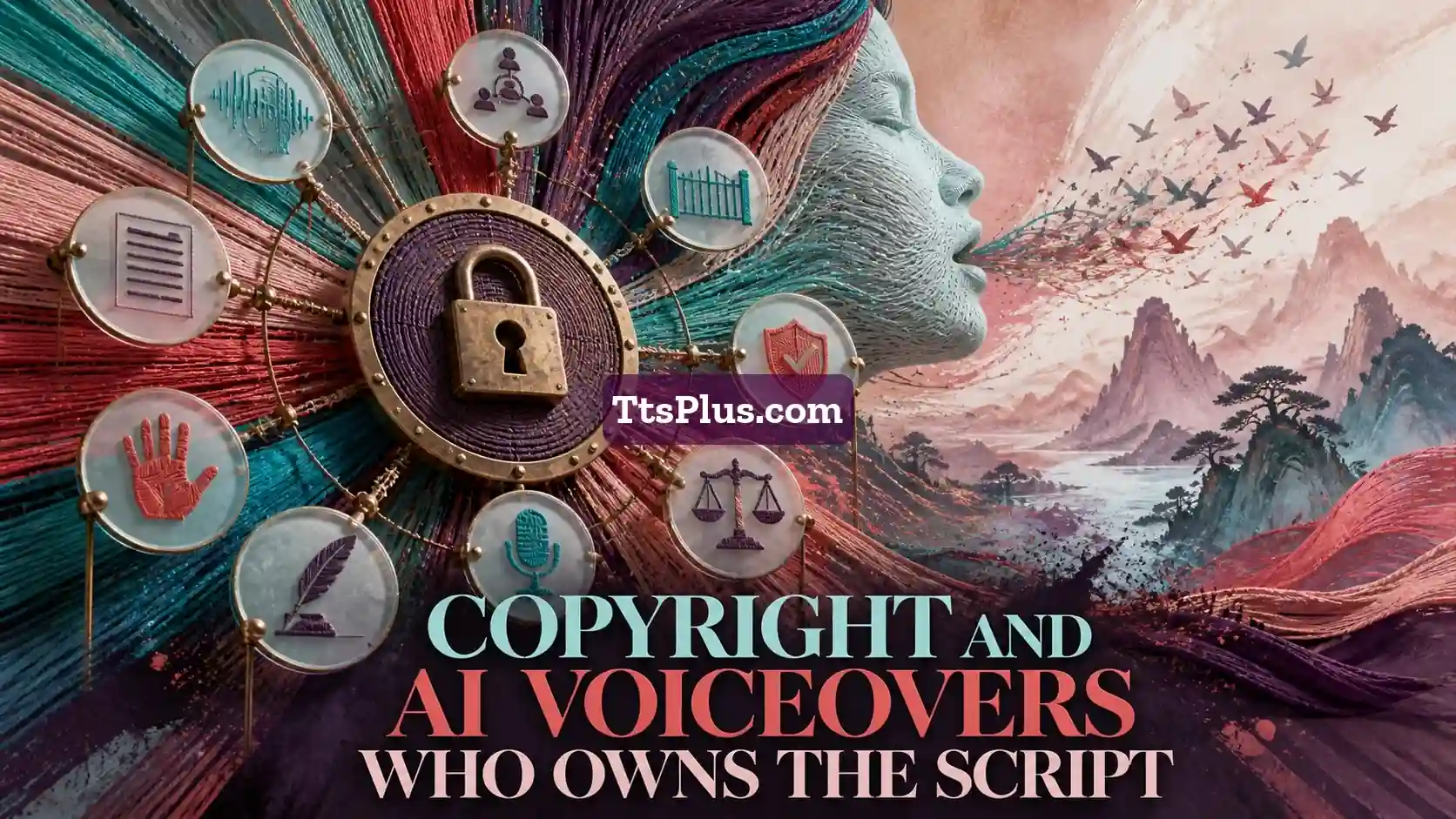
When evaluating ai voiceover copyright, ask four things separately: may you use the source text, may you use the selected or cloned voice, may you use any protected character or brand references, and does the destination platform allow the intended synthetic-media use? A yes to one question does not automatically answer the others.
For “Copyright and AI Voiceovers: Who Owns the Script?”, keep the final script, exported audio, relevant licences and speaker consent in one project record. This “Separate the rights into four simple questions” documentation is practical project hygiene—not legal advice—and makes later edits or disputes easier to understand.
Check the voice and speaker rights separately
A reliable workflow for ai voiceover copyright is simple: prepare a short script, choose one appropriate voice, generate a test, correct pronunciation or pacing, then produce the longer version in manageable sections. After the “Copyright and AI Voiceovers” result passes review, download the accepted audio and keep its source script beside it for future revisions.
When testing ai voiceover copyright, avoid changing voice, speed, expression and punctuation at the same time. During “Copyright and AI Voiceovers”, moving several controls at once makes it impossible to identify which edit improved the result. Small controlled tests make ai voiceover copyright more repeatable and save time on longer projects.
- During the “Copyright and AI Voiceovers” review, begin with a release checklist covering the script, voice, destination and approvals instead of generating the complete rights-cleared publication.
- For a repeatable ai voiceover copyright comparison, compare every revision at equal volume and score it for permission, disclosure, privacy and platform compliance.
- Before approving the “Copyright and AI Voiceovers” result, listen once in headphones and once in the platform, audience and commercial purpose of the final release before accepting the result.
- To keep “Copyright and AI Voiceovers” reproducible, separate wording, pronunciation, voice, speed and expression problems before changing controls.
- During the “Copyright and AI Voiceovers” review, archive the accepted script and settings beside the rights-cleared publication after the final review passes.
Commercial use depends on the destination too
For “Copyright and AI Voiceovers”, choose the voice for the intended listener and purpose rather than for novelty alone. For ai voiceover copyright, a voice that is easy to understand usually beats one that is merely unusual. Start “Copyright and AI Voiceovers” near a natural speaking rate, add expression only where meaning needs it, and normalize volume before mixing other audio.
For “Copyright and AI Voiceovers: Who Owns the Script?”, build the “Commercial use depends on the destination too” sample from ordinary prose plus one difficult name, number or abbreviation. That mix reveals how the real script behaves and provides a fairer test of permission, disclosure, accuracy and record keeping than a polished marketing sentence.
Disclosure can prevent audience confusion
Write for the ear. Prepare “Copyright and AI Voiceovers” by shortening dense sentences, removing visual-only formatting, expanding ambiguous abbreviations and marking natural breaths with punctuation. If a “Copyright and AI Voiceovers” listener must untangle the sentence, a more realistic voice will not repair the underlying writing. This is especially important for ai voiceover copyright because a clean source makes pronunciation and timing easier to diagnose.
For ai voiceover copyright, if a difficult name, number or phrase appears repeatedly, solve it once and reuse the correction. When “Copyright and AI Voiceovers” contains a stubborn name or term, use readable spelling or a saved TtsPlus pronunciation rule instead of repeatedly rewriting the full sentence.
Privacy and confidential information
Common mistakes with ai voiceover copyright include generating too much text before testing, choosing a voice only from a short demo, overusing emotional cues, ignoring pronunciation errors and assuming the first export is final. Do not create a separate “Copyright and AI Voiceovers” process for every search phrase when the listener, input and required output are actually the same.
For ai voiceover copyright, do not try to fix robotic speech by adding random commas everywhere or by pushing every slider to an extreme. In “Copyright and AI Voiceovers”, excessive pauses and emotion can be as distracting as flat delivery, so keep every cue tied to meaning.
Keep simple records of permissions and versions
Ai voiceover copyright can fit personal listening, creator workflows, education, narration, accessibility or business content depending on the subject. “Copyright and AI Voiceovers” is most useful when scripts change frequently, delivery must stay consistent, or recording every revision would slow the project.
When ai voiceover copyright will be used in public content, review the final audio in the same way you would review a human recording. Check facts, names, tone and context. Faster production for “Copyright and AI Voiceovers” does not excuse inaccurate wording, misleading claims or weak editorial review.
A final responsible-use checklist
Rights matter separately from technical ability. A tool used for “Copyright and AI Voiceovers” may process the words without granting rights to publish the script, imitate a person or reuse a protected performance. Confirm source rights and voice permission before “Copyright and AI Voiceovers” is used publicly or commercially. These checks apply to ai voiceover copyright just as they do to any other AI voice workflow.
Before exporting the final audio for “Copyright and AI Voiceovers: Who Owns the Script?”, compare it with the approved script, confirm the voice and settings, and check that no line or transition is missing. Finish the “A final responsible-use checklist” step with a short quality-control pass using the planned audience, publication channel and licence terms; small omissions are much easier to correct before the file is published or shared.
Quick takeaways
- Before producing “Copyright and AI Voiceovers: Who Owns the Script?” at full length, test a release checklist covering the script, voice, destination and approvals.
- In a real ai voiceover copyright test, compare revisions with identical source text and score the result for permission, disclosure, privacy and platform compliance.
- As you apply “Copyright and AI Voiceovers”, record the exact edit that solved the audible problem before moving to the next section.
- While refining “Copyright and AI Voiceovers”, archive the final script, selected voice and correction notes with the rights-cleared publication.
- Before approving the “Copyright and AI Voiceovers” result, finish with a privacy and rights review suited to the audience and destination of the rights-cleared publication.
Common questions
What should you test first for ai voiceover copyright?
Use a representative script plus a written rights and consent checklist and keep the source text unchanged for the first comparison. Listen for permission, disclosure, accuracy and record keeping, correct one clearly identified problem, and save the accepted settings before producing the full version described in “Copyright and AI Voiceovers”.
Which rights must be checked before publishing Copyright and AI Voiceovers?
Rights in the source script, voice, performance, music, characters, trademarks and other material can exist independently. The person publishing the work is responsible for checking the permissions that apply. For “Copyright and AI Voiceovers”, record the permission, disclosure and destination decision that applies to the planned publication before accepting the final result.
What should the final permission review cover for Copyright and AI Voiceovers?
Check the source text, selected or cloned voice, music, characters, trademarks, destination-platform rules and any required disclosure separately. Keep written permission and the final approved script with the project record. For “Copyright and AI Voiceovers”, record the permission, disclosure and destination decision that applies to the planned publication before accepting the final result.
Which records should be kept for Copyright and AI Voiceovers?
Keep the final script, output, source licences, voice permission, disclosure decisions and any platform approval together. A clear record makes later edits, complaints or rights checks easier to resolve. For “Copyright and AI Voiceovers”, record the permission, disclosure and destination decision that applies to the planned publication before accepting the final result.
Turn your text into natural speech with TtsPlus
Paste a script, choose a voice, adjust expression and download the result from the studio.